


The first question most people ask us is what it costs. The honest answer is that nobody can price software they have not scoped, and any studio that quotes before understanding the decision behind the work is guessing at your expense.
What a price list actually hides
A published day rate tells you what an hour costs. It tells you nothing about how many hours the work needs, who is on it, or whether the thing you asked for is the thing you need. Two projects that look identical in a brief can differ by a factor of three once you know what has to integrate, who has to sign off, and what happens on the busiest day of the month.
- —The systems the new work has to talk to, and how well documented they are.
- —Who owns the decision, and how many people can block it.
- —Whether the current process is written down anywhere, or lives in a few people's heads.
- —What has to be true for a release to be safe: records, access, audit, downtime.
- —Which parts you want to run yourselves once we hand over.
How we write a scope
It starts with ninety minutes, at Berkeley Square or on your floor, with the people who own the problem rather than the people who own the budget. We leave with one sentence: the decision this project has to serve. Everything after that is arithmetic.
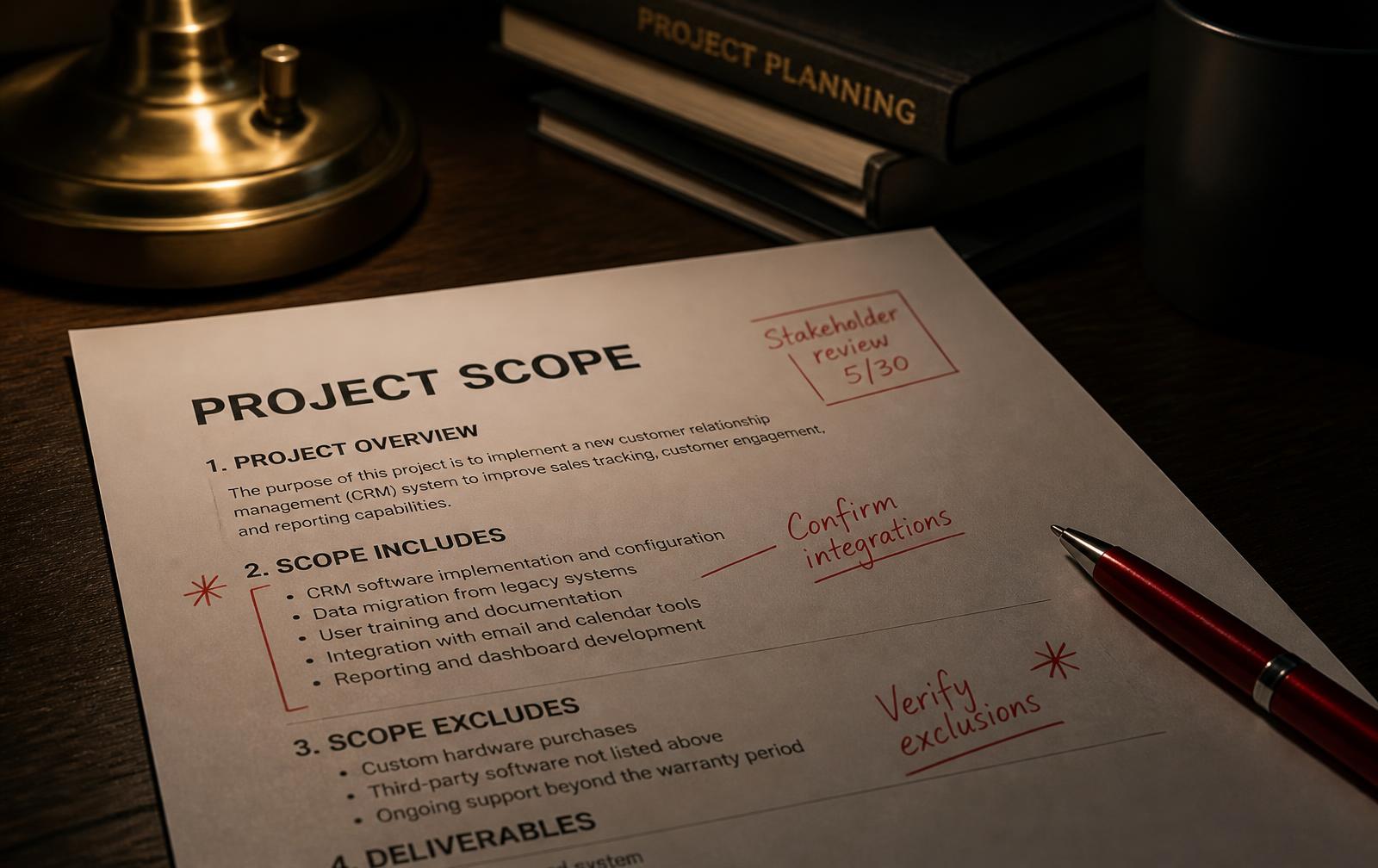
You then get named phases, named deliverables, the team on each one, and what is explicitly out. That last part matters more than the price. Most projects do not fail because the estimate was wrong; they fail because nobody wrote down what was not included.
If we cannot describe the deliverable in a sentence you would repeat to your board, it is not scoped yet.
How we test a scope before it is sent
What we need from you
A brief does not have to be polished. Tell us what has to work, by when, and what happens if it does not. That is enough for a senior member of the studio to reply with an honest read on scope, sequence, and whether we are the right studio for it.
Sometimes the answer is that you do not need us. We would rather say that in week one than bill you for finding out in month four.